Phrase (Basic ㊦ 304)
The speaker is convinced that there is no mistake on his part in guessing something.
Equivalent: There is no doubt that ~; must be ~; no doubt
| (i) {Vinformal/Adjective い} informal | に違いない | |
| {話す /話した} に違いない | Someone will no doubt talk/someone no doubt talked | |
| {食べる /食べた} に違いない | Someone will no doubt eat/someone no doubt ate | |
| {高い /高かった} に違いない | Something is/was no doubt expensive | |
| (ii) {Adjective な stem/ Noun} | {Ø/だった} に違いない | |
| {静か /静かだった} に違いない | Something is/was no doubt quiet | |
| {先生 /先生だった} に違いない | Someone is/was no doubt a teacher |
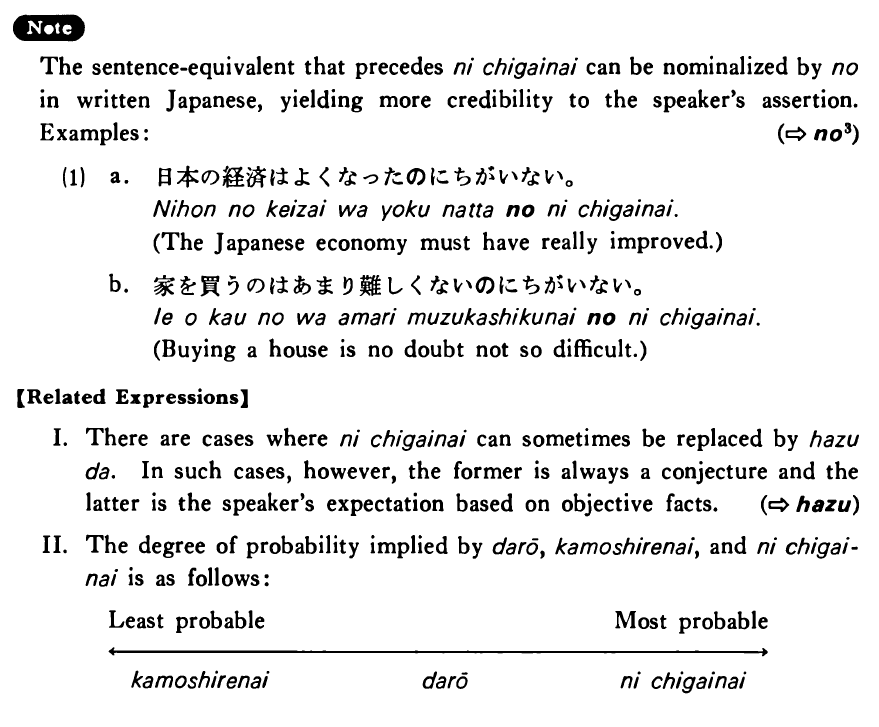
The sentence-equivalent that precedes に違いない can be nominalized by の in written Japanese, yielding more credibility to the speakers assertion. Examples:
(⇨ の3)
【Related Expressions】
I. There are cases where に違いない can sometimes be replaced by はずだ. In such cases, however, the former is always a conjecture and the latter is the speaker's expectation based on objective facts.
(⇨ はず)
II. The degree of probability implied by だろう, かもしれない, and に違いない is as follows:
| Least probable | Most probable | |
| かもしれない | だろう | に違いない |